
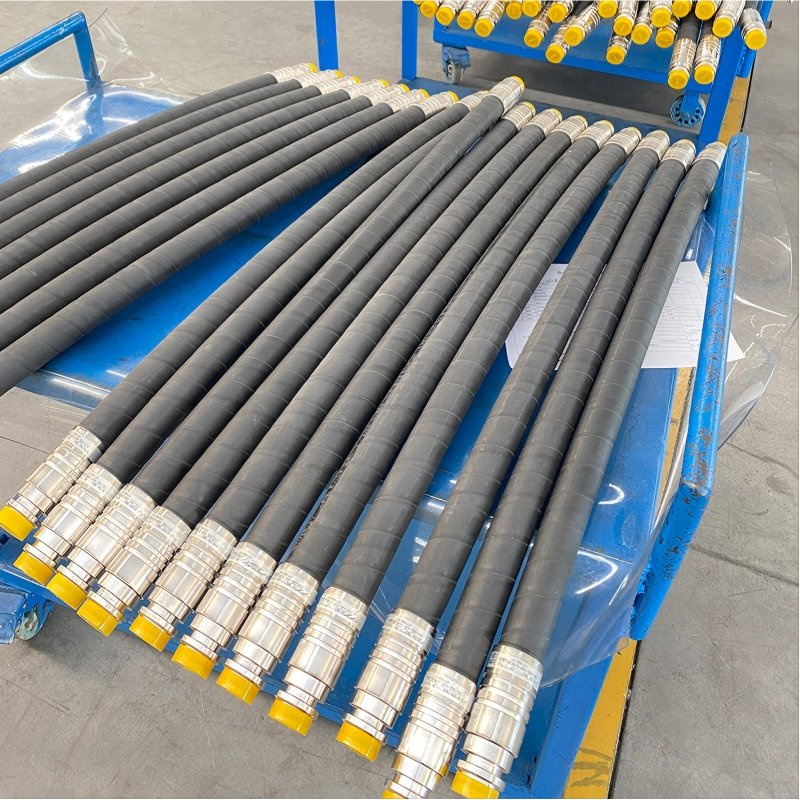
Hydraulic hose assemblies are flexible hydraulic piping components with rubber hoses as the body and crimped metal fittings at both ends. They are used in hydraulic systems to transmit pressurized oil, water-based hydraulic fluid, and emulsions. The key characteristic of these "assemblies" is that the hose body and fittings are pre-connected at the factory and have passed pressure testing, allowing users to directly install them between components such as hydraulic pumps, control valves, hydraulic cylinders, and hydraulic motors.
The core value that distinguishes hydraulic hose assemblies from bulk hoses lies in their connection reliability. The crimped fittings use the plastic deformation of the metal outer sleeve to tightly press the hose body onto the fitting core, creating a dual effect of mechanical locking and sealing. This process ensures that the assembly possesses sufficient tensile strength and sealing performance at rated operating pressure, avoiding quality fluctuations that may be introduced by on-site assembly fittings.
II. Structural Design and Material Composition Inner Layer (Inner Rubber Layer): Material selection depends on the type of hydraulic medium. Mineral-based hydraulic fluids are the most common medium in hydraulic systems. The inner layer is typically made of nitrile butadiene rubber (NBR), whose polar nitrile groups in its molecular structure give it excellent resistance to both mineral and synthetic oils. For phosphate ester hydraulic fluids, ethylene propylene diene monomer (EPDM) or butyl rubber must be used; for water-glycol hydraulic fluids, the suitability of the NBR inner layer formulation must be confirmed. The inner layer thickness is typically between 1.5 mm and 3.0 mm, and it must possess low permeability and good resistance to compression deformation.
Reinforcing Layer: The pressure-bearing core of the hydraulic hose. Reinforcing methods are mainly divided into two categories: steel wire braided structures, commonly one, two, or four layers of braid, suitable for medium- and high-pressure hydraulic systems; and steel wire wound structures, commonly four or six layers of wound, suitable for high-pressure and ultra-high-pressure hydraulic systems. The steel wire is made of high-carbon steel with a tensile strength of not less than 1800 MPa, and is copper- or zinc-plated to improve adhesion to the rubber. The braiding or winding angle is controlled at around 54°44' to balance radial pressure capacity and axial flexibility.
Outer Layer (Outer Rubber Layer): Primarily made of wear-resistant and weather-resistant synthetic rubber, typically a blend of chloroprene rubber (CR) or nitrile rubber and polyvinyl chloride. The outer layer must possess oil resistance, wear resistance, weather aging resistance, and ozone resistance to withstand oil, ultraviolet radiation, ozone, and mechanical friction in engineering machinery and industrial environments. Some products add flame retardants to the outer layer to meet flame retardant requirements in mining and marine applications.
Crimped Fittings: The core connecting component of the assembly. Fittings are typically made of carbon steel or stainless steel, with galvanized or passivated surfaces. Fitting types include metric threads, imperial threads, NPT threads, flanges, and quick-connect fittings, adaptable to different hydraulic system interface specifications. Key parameters of the crimping process include crimping pressure, crimping amount, and crimping length; these parameters determine the connection strength and sealing reliability between the fitting and the hose body.
III. Core Performance Parameters
Working Pressure: The working pressure range of hydraulic hose assemblies is wide, ranging from several MPa to tens of MPa. Two-layer braided steel wire hoses typically operate at pressures of 20MPa to 30MPa; four-layer spiral steel wire hoses can reach pressures exceeding 40MPa; ultra-high pressure products can operate at pressures exceeding 60MPa. Specific values depend on the inner diameter and reinforcement layer structure.
Burst Pressure: Not less than 3 to 4 times the operating pressure, providing ample safety margin.
Pulse Life: The fatigue life of hydraulic hoses under pressure cycling conditions is a key performance indicator. Standards require hoses to withstand at least 200,000 pressure pulse cycles at 133% of the rated operating pressure without failure.
Temperature Range: Standard products operate at temperatures ranging from -40℃ to +100℃, with some products extendable to +120℃.
Inner Diameter Specifications: Common inner diameters range from 5mm to 51mm, including 1/4 inch, 5/16 inch, 3/8 inch, 1/2 inch, 5/8 inch, 3/4 inch, 1 inch, 1-1/4 inch, 1-1/2 inch, and 2 inch sizes.
Bending radius: Related to the inner diameter and reinforcement structure, the bending radius of braided hoses is typically 5 to 8 times the hose diameter, while that of spiral wound hoses is slightly larger.
IV. Assembly Manufacturing and Quality Control
Hose Body Manufacturing: The hose body undergoes processes such as inner layer extrusion, reinforcement layer application, outer layer extrusion, and vulcanization. Vulcanization causes a cross-linking reaction in the rubber, bonding the layers into a unified structure.
Connector Crimping: Crimping is a critical process in assembly manufacturing. The crimping pressure, crimping amount, and crimping length must be precisely calculated based on the hose's inner diameter, reinforcement layer structure, and connector specifications. Insufficient crimping pressure will result in insufficient connection strength between the connector and the hose body; excessive crimping pressure will cause over-compression of the hose body's reinforcement layer, reducing the pressure-bearing capacity of that area.
Pressure Testing: The assembly must undergo a pressure test before leaving the factory, typically maintained at 1.5 times the working pressure for a certain period, observing for any leaks or abnormal deformation in the connector and hose body.
Tension Strength Verification: The connection strength between the connector and the hose body must meet the requirement of not experiencing axial slippage or detachment under the design pressure.
Online Message
Please fill in your name and message, and don't forget to email and/or call if you wish. We will reply within 24 hours.
