
Photovoltaic inverter liquid-cooled hoses are flexible piping components specifically designed for the liquid-cooled heat dissipation circuit of inverters in photovoltaic power generation systems. Photovoltaic inverters convert the direct current (DC) generated by photovoltaic modules into alternating current (AC) and connect it to the power grid. During this conversion process, the power modules generate heat. The liquid cooling system transfers this heat from the power modules to external heat sinks via circulating coolant. The liquid-cooled hoses provide flexible transport of the coolant within the piping system.
The operating environment of photovoltaic inverters is distinctly outdoor. Centralized inverters are typically installed in open areas such as deserts, Gobi, plateaus, and coastal regions, and are exposed to ultraviolet radiation, ozone, diurnal temperature variations, and wind erosion. String inverters, although installed near the photovoltaic module supports or combiner boxes, also face the continuous effects of outdoor climate. These environmental factors impose specific requirements on the weather resistance and ozone resistance of the outer layer material of the liquid-cooled hoses.
II. Material Selection and Weather Resistance Mechanism EPDM's Weather and Ozone Resistance Advantages: Ethylene propylene diene monomer (EPDM) rubber is a commonly used material for the outer layer of photovoltaic inverter liquid-cooled hoses. EPDM molecules have a saturated carbon backbone with only a small number of unsaturated double bonds in the side chains for vulcanization. This structural feature makes it significantly more resistant to ozone, ultraviolet (UV) radiation, and thermo-oxidative aging than rubbers like nitrile rubber (NBR) and styrene-butadiene rubber (SBR), which contain more unsaturated double bonds. Ozone aging typically begins at the unsaturated double bonds on the rubber surface, leading to crack initiation and propagation. EPDM's low unsaturation reduces its sensitivity to ozone attack at the molecular level.
UV Resistance System: Photovoltaic inverters are exposed to solar radiation for extended periods, and UV radiation is one of the main factors causing rubber aging. Carbon black is typically added to the outer layer of EPDM compound as a UV shielding agent. Carbon black absorbs UV radiation and dissipates the energy as heat, thus protecting the rubber molecular chains from UV-induced photo-oxidative degradation. Furthermore, UV absorbers and light stabilizers can be added to the compound formulation to further enhance UV resistance.
Synergistic Temperature and Weather Resistance: Photovoltaic inverters experience diurnal temperature variations and seasonal temperature changes during outdoor operation. Liquid cooling systems typically operate in the range of -40°C to +100°C. EPDM maintains its elasticity and sealing performance over a wide temperature range. Its low glass transition temperature makes it less prone to embrittlement at low temperatures and less prone to softening and deformation at high temperatures. This temperature adaptability allows the liquid-cooled hose to maintain stable function under all-weather operation conditions in photovoltaic power plants.
III. Structural Design and Performance Parameters
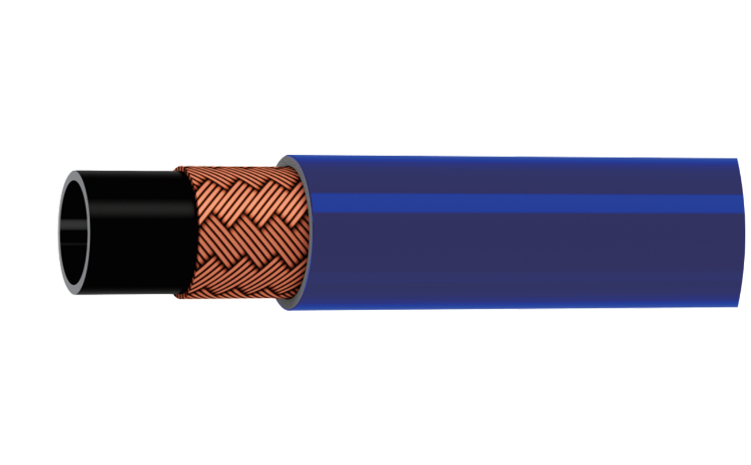
Inner Layer (Inner Rubber Layer): Primarily made of peroxide-cured EPDM. Compared to sulfur-cured systems, peroxide curing forms a more uniform cross-linked network and has a lower extractable content, helping to maintain the cleanliness and electrical insulation performance of the coolant. The inner layer must be compatible with the cooling medium, which is typically a water-ethylene glycol mixture or a specialized coolant. The inner layer thickness is typically between 1.5 mm and 3.0 mm.
Reinforcing Layer: Utilizes synthetic fiber braiding or aramid yarn braiding to provide pressure resistance. For liquid cooling systems operating at higher pressures, a steel wire braided reinforcement structure can be selected. The braiding angle is controlled around 54°44' to balance pressure resistance and flexibility.
Outer Layer (Outer Adhesive Layer): Primarily made of weather-resistant EPDM, with a thickness typically between 1.0mm and 2.5mm. This outer layer serves as the first line of defense against UV radiation, ozone, and mechanical abrasion. Weather resistance is achieved through carbon black filler and an antioxidant system in the outer layer formulation. A marking strip is usually present along the length of the outer layer surface.
Operating Pressure: The operating pressure of a photovoltaic inverter liquid cooling system typically ranges from 0.3MPa to 0.8MPa. The rated operating pressure of the hose is generally designed to be 2 to 3 times the maximum operating pressure of the system, with a burst pressure no less than 4 times the operating pressure.
Temperature Range: Standard products operate from -40℃ to +100℃, with some products extendable to +120℃.
Bending Radius: Liquid cooling hoses require wiring within the compact space of the inverter cabinet or heat dissipation module; the bending radius is typically between 3 and 5 times the hose diameter.
Electrical Insulation Performance: EPDM material has high volume resistivity, making it suitable for liquid cooling piping applications requiring electrical insulation. For high-voltage inverter systems, the insulation performance of the flexible hose helps maintain the system's insulation level.
IV. Key Considerations for Photovoltaic Scenarios
UV Protection: Photovoltaic power plants are mostly located in areas with abundant sunshine and high UV radiation intensity. The UV resistance of the outer layer directly determines the service life of the flexible hose in outdoor environments. Carbon black filler content, particle size, and dispersion have a significant impact on UV shielding effectiveness.
Ozone Resistance: Ozone sources may exist around the inverter, including corona discharge from high-voltage electrical equipment and the interaction of UV radiation with the air. The low unsaturation of EPDM provides ozone resistance at the molecular structure level.
Temperature Cycling: Photovoltaic inverters cycle between high-load operation during the day and low-load or shutdown at night, causing temperature fluctuations in the liquid cooling system. The flexible hose must maintain its sealing integrity and structural stability under repeated thermal expansion and contraction.
Coastal and Industrial Environments: Photovoltaic power plants and industrial plant photovoltaic systems may face corrosion from salt spray and chemical pollutants. The outer layer must possess corresponding chemical corrosion resistance.
Installation and Maintenance: The installation of liquid-cooled hoses for photovoltaic inverters should avoid excessive bending and twisting. The spacing between hose supports should be set appropriately based on the hose diameter and medium temperature. Regularly inspect the outer layer for cracks, hardening, and signs of wear, and replace aged hoses promptly.
Online Message
Please fill in your name and message, and don't forget to email and/or call if you wish. We will reply within 24 hours.
