
1. Product Definition and Applicable Standards
The API 16C rotary drilling hose is a specialized flexible conduit used in well control systems for connecting choke and kill manifolds to the blowout preventer (BOP) stack. Unlike API 7K rotary drilling hoses that primarily convey drilling mud from the mud pump to the standpipe, API 16C hoses are engineered for a distinct set of operating conditions: they must handle high-pressure fluids containing hydrogen sulfide (H₂S) and other corrosive gases, withstand fire exposure, and maintain pressure integrity during emergency well control operations.
The governing specification for this product category is API Spec. 16C (Specification for Choke and Kill Systems), which establishes design, manufacturing, testing, and certification requirements for choke and kill manifold flexible hoses. The standard classifies hoses by working pressure and flexibility level, with FSL 3 (Flexible Service Level 3) representing the most demanding classification for applications involving relative motion between connected equipment.
2. Structural Design and Material Composition
The API 16C hose adopts a multi-layer composite construction, with each functional layer engineered to address specific performance requirements.
Inner Tube: The fluid barrier layer is typically manufactured from hydrogenated nitrile butadiene rubber (HNBR) or a specialized elastomer compound. HNBR is selected for its resistance to H₂S and other acidic gases commonly encountered in sour service wells. The inner tube must maintain sealing integrity under rapid pressure fluctuations and elevated temperatures while resisting permeation by aggressive well fluids.
Reinforcement Layer: The pressure containment structure consists of multiple layers of high-tensile steel wire helically wound in alternating directions. Common constructions include four or six layers of high-strength wire, with the number of layers determining the working pressure rating. The wire is typically high-carbon steel with a tensile strength exceeding 2000 MPa, coated with a bonding agent to ensure adhesion to the surrounding rubber layers.
Fire Barrier Layer: An intermediate thermal barrier layer composed of ceramic fiber or intumescent material provides insulation against external heat. This layer retards heat transfer from the external flame to the inner pressure-retaining layers, enabling the hose to maintain pressure integrity during fire exposure.
Outer Cover: The exterior layer is formulated from a flame-retardant synthetic rubber compound. In addition to flame resistance, the outer cover provides resistance to ozone, weathering, and mechanical abrasion encountered on offshore platforms and drilling rigs.
Stainless Steel Armor: Many API 16C hoses incorporate a stainless steel armor layer applied over the outer cover. The armor serves multiple functions: protecting against mechanical impact and abrasion, reflecting radiant heat during fire exposure, and providing additional thermal shielding to the inner layers.
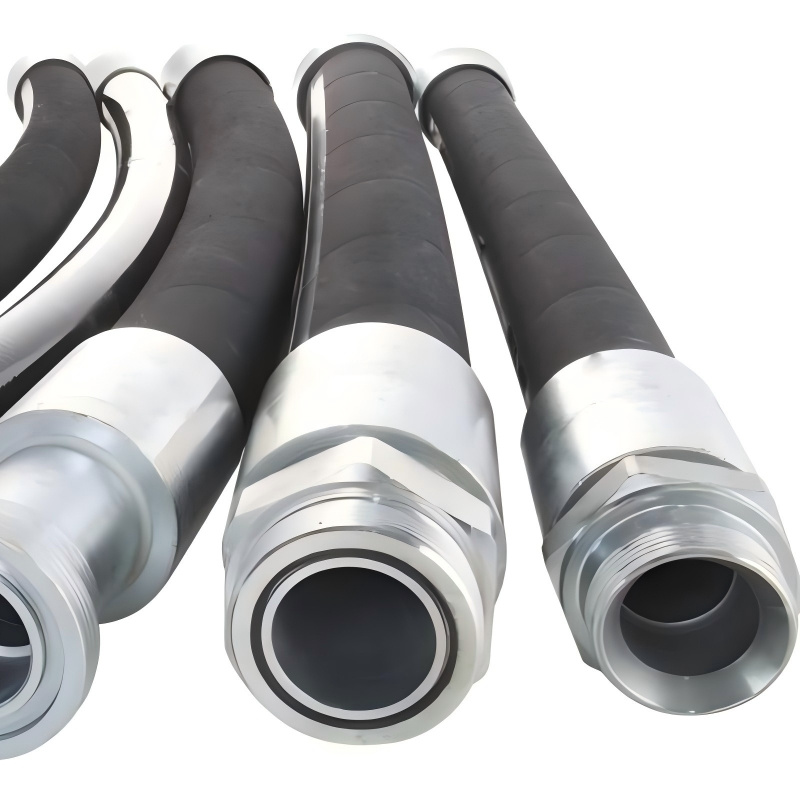
End Fittings: The hose ends are fitted with high-pressure connectors, typically hammer unions or flanged connections, attached via swaging or crimping processes. The connection zone is protected with fire-resistant sleeves or heat-shrinkable wraps to ensure the fitting area meets the same fire resistance standard as the hose body.
3. Key Performance Specifications
Working Pressure: API 16C hoses are available in pressure ratings ranging from 5000 psi to 15000 psi (approximately 34.5 MPa to 103.4 MPa), with some specialized configurations reaching 20000 psi for ultra-high-pressure applications. The pressure rating is determined by the number of reinforcement layers and the hose diameter.
Fire Resistance: The core performance requirement is zero leakage when exposed to an open flame at 704°C ± 50°C while pressurized to the rated working pressure for a duration of 5 minutes. This test simulates the fire conditions that could occur on a drilling rig or offshore platform, ensuring the hose can maintain pressure containment during emergency well control operations.
Temperature Range: Standard products operate within a temperature range of -40°C to +100°C, with some versions extended to +121°C or +150°C for high-temperature well applications.
Minimum Bend Radius: Depending on the hose diameter and pressure rating, the minimum bend radius typically ranges from 1000 mm to 1800 mm. The bend radius is a critical parameter for installation layout and hose fatigue life.
H₂S Resistance: For sour service applications, the hose materials must meet NACE MR0175 / ISO 15156 requirements for resistance to sulfide stress cracking. This is particularly important for hoses used in choke and kill manifold systems where produced fluids may contain H₂S.
Flexibility Levels: API 16C defines flexibility levels FSL 0 through FSL 3. FSL 3 is required for applications involving dynamic motion, such as floating drilling vessels where the hose experiences cyclic bending and tension due to vessel motion.
4. Application in Choke and Kill Systems
The primary application of API 16C hoses is in the choke and kill manifold systems that connect to the BOP stack. These hoses serve two critical functions:
Kill Line: The kill line provides a pathway for pumping heavy kill fluid into the wellbore to control a kick or blowout. The hose must withstand the high pressures required to overcome reservoir pressure and must maintain integrity if the well fluid contains H₂S.
Choke Line: The choke line routes wellbore fluids from the BOP stack to the choke manifold, where the flow is controlled during well control operations. The hose must handle high-velocity abrasive fluids and maintain pressure integrity during extended flow periods.
In subsea applications, the choke and kill hoses are typically integrated into the subsea umbilical or deployed as separate flexible lines from the surface vessel to the subsea BOP stack. The hoses must withstand both internal pressure from well fluids and external hydrostatic pressure at depth.
5. Selection and Specification Guidelines
When specifying an API 16C hose for a drilling operation, the following parameters should be evaluated:
Working Pressure: Match the hose pressure rating to the maximum anticipated well control pressure, including safety margin for pressure surges.
H₂S Content: For sour service wells, verify that the hose materials meet NACE requirements for sulfide stress cracking resistance.
Fire Resistance Level: Confirm that the manufacturer’s fire test documentation covers the specified hose configuration, including end fittings.
Temperature Range: Evaluate both internal fluid temperature and external ambient temperature against the hose rating.
Bend Radius and Installation Layout: Verify that the hose bend radius is compatible with the available routing space on the rig or platform.
End Fitting Compatibility: Ensure that the fitting type and size match the existing choke and kill manifold connections.
Certification Documentation: Obtain the manufacturer‘s API 16C compliance certificate, fire test reports, and material certification documents.
Online Message
Please fill in your name and message, and don't forget to email and/or call if you wish. We will reply within 24 hours.
