
1. Technology Overview and Definition
High Pressure Processing (HPP), also referred to as high pressure pasteurization or cold pasteurization, is a non-thermal food preservation method that subjects packaged products to ultra-high hydrostatic pressure transmitted through water. The process operates at pressures up to 600 MPa (6,000 bar or 87,000 psi), which is equivalent to the pressure found at a depth of approximately 60,000 meters underwater. This pressure is applied uniformly and almost instantaneously throughout the product, achieving a pasteurization effect without the application of heat.
The technology was first commercially applied in Japan during the 1990s for fruit juice preservation and has since expanded globally across multiple food categories. HPP is recognized as a clean-label enabling technology because it reduces or eliminates the need for chemical preservatives while extending product shelf life and ensuring microbiological safety.
2. Operating Principle and Mechanism
The fundamental mechanism of HPP involves placing pre-packaged food products into a high-pressure vessel filled with water. The water is compressed to approximately 15% to 18% of its original volume to achieve the target pressure of 600 MPa. The pressure is held for a duration typically ranging from 2 to 5 minutes, depending on the product type and target microorganisms.
The inactivation of microorganisms occurs through several simultaneous effects: the high pressure disrupts bacterial cell membranes, damages ribosomes and enzymes, and alters the cellular morphology of microorganisms. Critical cellular components, including proteins involved in DNA replication and transcription, are also affected. Because the pressure is transmitted uniformly through water, the treatment is consistent throughout the product regardless of its shape or size.
Unlike thermal pasteurization, HPP does not use heat to destroy pathogens. It is therefore commonly performed at refrigerated (4°C to 10°C) or ambient temperatures, which preserves the natural sensory and nutritional properties of the food.
3. Key Technical Specifications
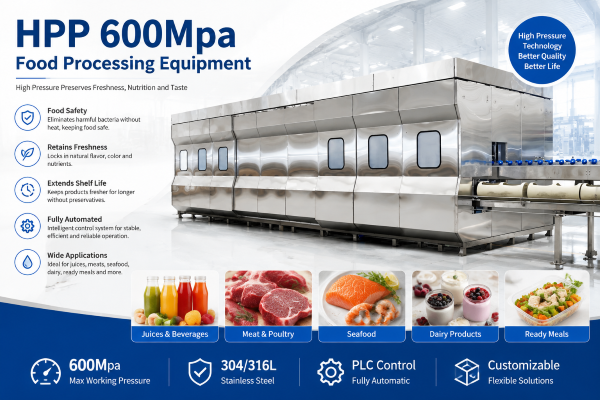
Pressure Capability: Standard HPP equipment operates at a maximum working pressure of 600 MPa. This is the industry benchmark for cold pasteurization applications. Some specialized research and development systems can reach up to 1,000 MPa for experimental purposes.
Vessel Volume: Commercial HPP equipment is available in a range of vessel capacities. Laboratory and pilot-scale units start from 3 to 50 liters, while industrial-scale production equipment typically ranges from 100 liters up to 525 liters per vessel. A typical production model such as the HPP-5YG features a 300-liter vessel capacity with a cycle time of 6 to 8 batches per hour.
Cycle Time and Throughput: The pressurization time to reach 600 MPa is typically less than 2 to 5 minutes. Total cycle time, including loading, pressurization, holding, and decompression, determines the hourly throughput. A well-optimized industrial HPP system processes 6 to 8 batches per hour.
Vessel Construction: Pressure vessels are constructed from high-grade stainless steel, typically 316 stainless steel, to withstand the extreme pressures and resist corrosion from water and food contact.
Operating Temperature: While HPP is fundamentally a cold pasteurization technique, equipment can operate across a temperature range from ambient up to 80°C for specific applications. The working medium is typically drinking water maintained at 5°C to 20°C.
Power Consumption: Industrial HPP equipment typically consumes between 7.5 kW and 25 kW per cycle, depending on vessel size and throughput specifications.
4. Applications Across Food Categories
Juices and Beverages
HPP is the technology behind the premium cold-pressed juice market. By processing juices at room temperature, it eliminates the "cooked" flavor associated with thermal pasteurization while fully preserving heat-sensitive nutrients such as vitamins, anthocyanins, and active enzymes. HPP-treated juices achieve extended shelf life while maintaining their natural fresh taste and color.
Meat and Ready-to-Eat Meats
HPP has proven highly effective for ready-to-eat meat products. The technology eliminates pathogens including Listeria monocytogenes, Salmonella enterica, and Staphylococcus aureus without the need for chemical preservatives or high heat. Research demonstrates that HPP treatment at 600 MPa on various meat products results in almost zero counts of these pathogens. Shelf life for HPP-treated ready-to-eat meat extends from 4 weeks (with standard processing) to up to 10 weeks. The process also enhances saltiness perception, potentially allowing sodium reduction without compromising taste.
Seafood and Shellfish
In shellfish processing, HPP provides unique advantages beyond preservation. The pressure instantly detaches meat from shells, enabling 100% meat recovery with minimal labor. This automated shucking process eliminates the need for manual labor and boiling. The technology also eliminates harmful bacteria such as Vibrio species, ensuring a safer product with extended shelf life.
Guacamole and Avocado Products
HPP has become standard for guacamole and avocado-based products. The pressure prevents enzymatic browning while inactivating spoilage organisms, preserving the fresh green color and texture without chemical additives.
Plant-Based Products, Salsas, and Fruit Purees
The technology is widely applied to salsas, fruit purees, and plant-based products. Research comparing HPP with thermal processing found that antioxidant activity of strawberry and blackberry purees was reduced by only 5% under HPP, compared to 25% reduction through thermal processing. HPP also demonstrated superior retention of ascorbic acid (vitamin C).
Baby Food and Pet Food
The clean-label nature of HPP makes it suitable for baby food and raw pet food products. It eliminates pathogens such as Salmonella and Listeria in raw pet food formulations without cooking the product, ensuring the safety of raw diets while retaining full nutritional value.
Ready-to-Eat Meals and Dairy
For the convenience food market, HPP extends shelf life while maintaining fresh taste and texture. Applications include soups, sauces, complete meal kits, fresh cheeses, yogurts, and milk-based spreads. The technology also enables texture modification in dairy products for novel product development.
5. Product Preservation and Shelf Life Extension
HPP processing significantly extends the refrigerated shelf life of perishable products. The exact shelf life extension depends on product formulation, processing parameters, and storage temperature. Typical shelf life ranges from 30 to 90 days for HPP-treated products, compared to only 7 to 15 days for conventional products. Some HPP products achieve shelf life up to 120 days under optimal conditions.
HPP-treated products require refrigerated storage (0°C to 4°C) because the process does not inactivate bacterial spores under normal chilled or ambient conditions. The cold chain from processing through distribution to retail display must be maintained to ensure product safety and quality throughout the extended shelf life.
The nutritional retention advantage of HPP over thermal processing is significant. Antioxidant activity and ascorbic acid retention are substantially higher in HPP-treated fruit products compared to thermally pasteurized equivalents.
6. Advantages and Limitations
Advantages
-
Preservation of Sensory Quality: HPP maintains the natural flavor, color, texture, and nutritional value of fresh products.
-
Pathogen Inactivation: Effectively eliminates vegetative pathogens including Listeria, Salmonella, E. coli, and Vibrio.
-
Clean Label: Reduces or eliminates the need for chemical preservatives, meeting consumer demand for additive-free products.
-
Shelf Life Extension: Extends refrigerated shelf life to 30–90 days or longer.
-
Reduced Energy Consumption: Compared to thermal processing, HPP consumes significantly less energy (over 30% reduction by some estimates).
Limitations
-
Spore Inactivation: Conventional HPP does not inactivate bacterial spores; refrigerated storage is therefore required.
-
Product Suitability: HPP is most effective for high-moisture products with sufficient free water. It is generally not suitable for low-moisture products such as spices, powders, dry nuts, or baked goods.
-
Frozen Products: Conventional HPP is not effective for fully frozen products; products must be thawed before processing.
-
Batch Processing: HPP is a batch operation, which may limit throughput compared to continuous thermal processes.
7. Equipment Supply and Contract Manufacturing
HPP equipment is available through specialized manufacturers offering both equipment sales and contract manufacturing (OEM) services. Industrial HPP systems are supplied with vessel volumes ranging from 40 liters to 612 liters, with standard models operating at 600 MPa working pressure.
For food manufacturers evaluating HPP technology, contract manufacturing services provide an opportunity to test product formulations and market acceptance without the capital investment in equipment. OEM partners offer processing capabilities with production line data monitoring for quality control and traceability.
Online Message
Please fill in your name and message, and don't forget to email and/or call if you wish. We will reply within 24 hours.
